
4 Stages of Appendicitis: Symptoms, Causes, Diagnosis, and Treatment
Appendicitis is a common medical condition that happens when the appendix becomes inflamed and infected. The appendix is a small, finger-shaped pouch connected to the large intestine, located in the lower-right area of the abdomen. Although the appendix does not appear to be essential for normal digestion, inflammation of this organ can become a serious health problem if it is not treated in time. Appendicitis can affect people of different ages, including children, teenagers, and adults. In some cases, the condition begins with mild abdominal discomfort but gradually becomes more painful and serious.
Understanding the 4 stages of appendicitis can help people recognize how the condition may develop over time. These stages generally describe increasing inflammation, infection, tissue damage, and possible rupture of the appendix. However, appendicitis does not always progress at the same speed in every person. Some people may develop serious complications relatively quickly, while others may have a slower progression. For this reason, anyone experiencing unexplained or worsening abdominal pain should seek medical evaluation instead of waiting for symptoms to become severe.
What Are the 4 Stages of Appendicitis?
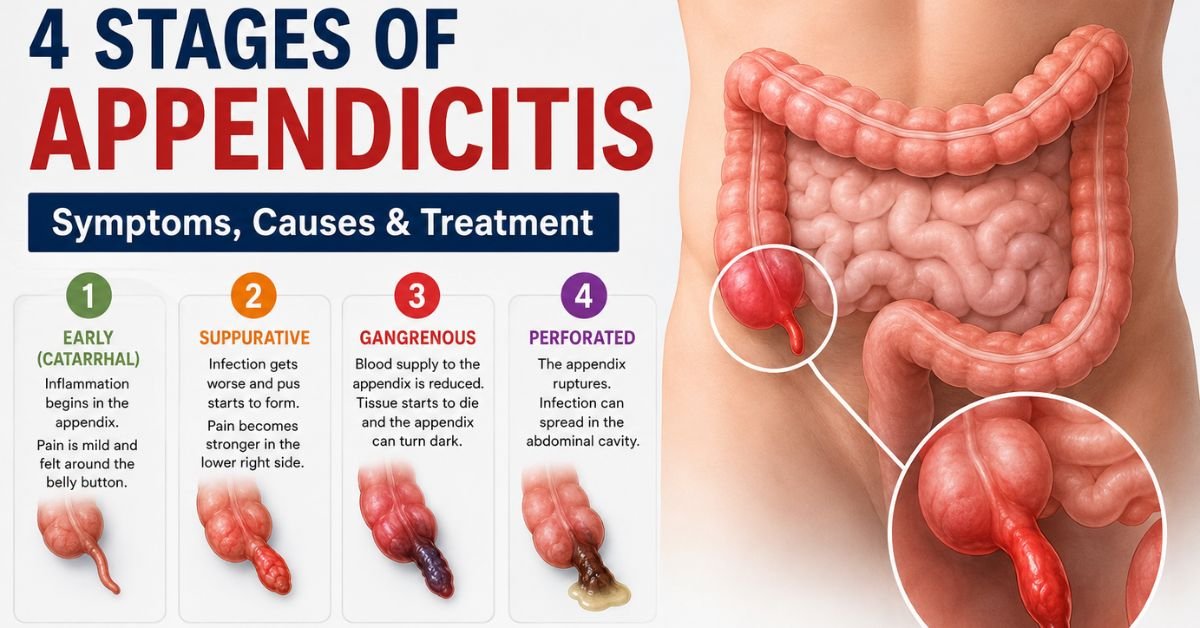
The 4 stages of appendicitis are commonly described as early or catarrhal appendicitis, suppurative appendicitis, gangrenous appendicitis, and perforated or ruptured appendicitis. These stages describe what may happen inside and around the appendix as inflammation and infection become more severe. The first stage usually involves inflammation, while later stages can involve pus formation, tissue death, and eventually a hole or rupture in the appendix.
It is important to understand that these stages are a general way of describing the progression of appendicitis rather than a precise timeline that every patient follows. A person cannot accurately determine the stage of appendicitis simply by looking at their symptoms. Doctors may need to perform a physical examination, blood tests, imaging tests, or surgery to determine how severe the inflammation is. Early medical assessment is therefore important when appendicitis is suspected.
Stage 1: Early or Catarrhal Appendicitis
The first stage is often described as early, simple, or catarrhal appendicitis. During this stage, inflammation begins inside the appendix. One possible reason is that the opening of the appendix becomes blocked, preventing its contents from moving normally. The blockage can increase pressure inside the appendix and create an environment where bacteria can multiply. As the body’s immune system responds to the problem, inflammation begins to develop.
During early appendicitis, symptoms may be relatively mild and can sometimes be confused with indigestion or another minor stomach problem. Abdominal pain may initially develop around the belly button or in the middle of the abdomen before gradually moving toward the lower-right side. A person may also experience loss of appetite, mild nausea, bloating, or a low-grade fever. Because early symptoms can be difficult to recognize, some people may delay seeking medical care.
Although the first stage may not initially seem severe, it should not be ignored. Appendicitis can progress from early inflammation to a more serious infection. The exact speed of progression varies from person to person, so there is no safe period that a person should wait before getting checked. If abdominal pain continues, becomes stronger, or is accompanied by fever, vomiting, or significant tenderness, professional medical evaluation is recommended.
Stage 2: Suppurative Appendicitis
The second stage is known as suppurative appendicitis. At this point, the inflammation has become more advanced, and infection can develop within the appendix. Pus may begin to form as the immune system responds to bacterial infection. The appendix can become increasingly swollen and irritated, and inflammation may begin to affect nearby tissues. This stage is more serious than simple early inflammation and generally requires prompt medical attention.
Pain often becomes stronger and more localized during this stage. Many people experience pain in the lower-right part of the abdomen, although the exact location can vary depending on the position of the appendix and the individual. The pain may become worse when walking, coughing, or making sudden movements. Other symptoms can include fever, nausea, vomiting, loss of appetite, abdominal tenderness, constipation, or diarrhea. Not every person will have all of these symptoms.
Suppurative appendicitis should be evaluated by a healthcare professional as soon as possible. Doctors may use a combination of physical examination, blood tests, ultrasound, CT imaging, or other tests to determine whether appendicitis is present. Depending on the patient’s condition, treatment may involve antibiotics and surgical removal of the appendix. Early treatment can help prevent the infection and inflammation from progressing to tissue damage or rupture.
Stage 3: Gangrenous Appendicitis
The third stage is called gangrenous appendicitis. This is a more advanced form of the disease in which severe inflammation and swelling can interfere with the blood supply to the appendix. When tissues do not receive enough blood and oxygen, they can become damaged and eventually die. This process is known as gangrene. Gangrenous appendicitis is considered a serious condition because damaged tissue is weaker and may be more likely to perforate or rupture.
A person with advanced appendicitis may experience significant abdominal pain, fever, nausea, vomiting, weakness, and marked tenderness. However, symptoms are not always predictable. In some cases, pain may temporarily change or even seem to improve when tissue damage affects the nerves in the appendix. This temporary improvement should not be considered a sign that the condition has gone away. The infection and tissue damage may continue even when the pain pattern changes.
Gangrenous appendicitis requires urgent medical assessment and treatment. Doctors will consider the patient’s symptoms, examination results, laboratory findings, and imaging studies when deciding on treatment. Surgery to remove the appendix is commonly required in serious cases, while antibiotics may also be used to control infection. Prompt treatment is important because a damaged appendix can eventually develop a hole, allowing infected material to spread into the abdomen.
Stage 4: Perforated or Ruptured Appendicitis
The fourth stage is known as perforated or ruptured appendicitis. This is one of the most serious complications of appendicitis. A rupture can occur when inflammation, infection, pressure, and tissue damage weaken the wall of the appendix until a hole develops. Once the appendix perforates, infected material can leak into the abdominal cavity. This can cause inflammation and infection of the abdominal lining, a condition known as peritonitis.
A ruptured appendix may cause severe or worsening abdominal pain, fever, chills, vomiting, weakness, abdominal swelling, and a general feeling of being seriously ill. However, symptoms can differ between individuals, and some people may not experience every warning sign. In some cases, the body may form a localized abscess around the appendix, which can contain the infection. Even when the infection is contained, medical treatment is still necessary.
Perforated appendicitis is a medical emergency and requires urgent treatment. Treatment may involve antibiotics, surgery to remove the appendix, drainage of an abscess, or a combination of these approaches. The exact treatment depends on the patient’s overall condition and whether the infection has spread. Delaying treatment after rupture can increase the risk of serious complications, including widespread abdominal infection and sepsis.
Common Symptoms of Appendicitis
The symptoms of appendicitis can vary depending on the person’s age, the position of the appendix, and the stage of inflammation. One of the most commonly recognized symptoms is abdominal pain. The pain may begin around the belly button and later become more noticeable in the lower-right abdomen. It may gradually become stronger and can worsen with movement, coughing, walking, or pressing on the affected area.
Other common symptoms include loss of appetite, nausea, vomiting, fever, abdominal tenderness, bloating, constipation, or diarrhea. Some people may also feel generally weak or unwell. Children may have difficulty explaining exactly where the pain is located, while older adults may have less typical symptoms. Pregnant people can also experience a different location of abdominal pain because pregnancy changes the position of abdominal organs.
Because many other medical conditions can cause similar symptoms, it is not possible to diagnose appendicitis based only on symptoms. A stomach infection, kidney stone, urinary infection, intestinal condition, or certain reproductive-system conditions can also cause abdominal pain. This is why persistent or worsening abdominal pain should be assessed by a healthcare professional rather than treated as ordinary stomach discomfort.
What Causes Appendicitis?
Appendicitis often begins when the opening of the appendix becomes blocked. The blockage may sometimes be caused by hardened stool, swelling of lymphoid tissue, or other less common factors. When the appendix becomes blocked, bacteria can multiply inside it, causing inflammation and swelling. As pressure increases, blood flow to the appendix can become affected, which may contribute to tissue damage and eventually perforation.
In some cases, doctors cannot identify one clear reason why a person’s appendix became inflamed. Appendicitis is not necessarily caused by eating a particular food, and it is not always possible to prevent it through lifestyle changes. Although maintaining a generally healthy lifestyle is beneficial for overall health, there is no guaranteed method that completely prevents appendicitis.
How Is Appendicitis Diagnosed?
Doctors diagnose appendicitis by looking at the patient’s symptoms, medical history, and physical examination. During an examination, a doctor may gently press different areas of the abdomen to identify tenderness or other signs of inflammation. Blood tests may also be performed to look for signs of infection or inflammation, although blood tests alone cannot confirm appendicitis.
Imaging tests can provide additional information. An ultrasound may be used to examine the appendix and surrounding tissues, particularly in children or pregnant patients. A CT scan can provide detailed images of the abdomen and may help doctors identify an inflamed, enlarged, or perforated appendix. The choice of test depends on the patient’s age, symptoms, medical history, and clinical situation.
Treatment for Appendicitis
Treatment depends on the severity of appendicitis and the patient’s individual circumstances. In many cases, an appendectomy is performed to remove the inflamed appendix. An appendectomy may be performed using laparoscopic surgery, which involves several small incisions, or through an open surgical approach when appropriate. The medical team chooses the most suitable approach based on the patient’s condition.
Antibiotics are commonly used when infection is present and may be given before and after surgery. In selected cases of uncomplicated appendicitis, doctors may consider treating the condition with antibiotics without immediate surgery. However, this approach is not appropriate for every patient, and appendicitis can return in some people treated without surgery. A doctor should determine the most appropriate treatment.
If appendicitis has caused an abscess, treatment can be more complicated. Doctors may use antibiotics and sometimes drain the abscess to control the infection. Surgery may be performed immediately or at a later stage depending on the patient’s condition and the extent of infection. People with complicated appendicitis may require a longer recovery period and closer medical monitoring.
Can Appendicitis Be Prevented?
There is no guaranteed way to prevent appendicitis because its exact cause is not always known. Although some cases may be associated with blockage of the appendix, there is no specific diet, supplement, or daily routine that can completely eliminate the risk. Maintaining good general health and eating a balanced diet can support overall digestive health, but these habits should not be considered a guaranteed method of preventing appendicitis.
The most important step is recognizing possible symptoms and seeking medical care without unnecessary delay. If abdominal pain becomes persistent or progressively worse, especially when it moves toward the lower-right abdomen, it should be taken seriously. Early assessment can help doctors identify appendicitis before it progresses to more complicated stages.
When Should You See a Doctor?
You should seek urgent medical attention if you develop persistent or worsening abdominal pain, particularly if the pain becomes concentrated in the lower-right side of your abdomen. Fever, repeated vomiting, significant abdominal tenderness, swelling, weakness, or feeling increasingly unwell can also indicate that immediate medical evaluation is needed. It is better to have unexplained abdominal pain checked than to assume it is simply indigestion.
You should not wait for your symptoms to match all 4 stages of appendicitis before seeking treatment. A person cannot reliably determine the stage of appendicitis at home, and the condition can progress differently from one individual to another. If you have severe or worsening abdominal pain, seek professional medical care promptly rather than attempting to diagnose or treat the condition yourself.
Conclusion
The 4 stages of appendicitis are commonly described as early or catarrhal appendicitis, suppurative appendicitis, gangrenous appendicitis, and perforated or ruptured appendicitis. These stages generally represent increasing inflammation and infection, followed by possible tissue death and rupture. Understanding this progression explains why appendicitis should be taken seriously and why timely medical evaluation is important.
The symptoms of appendicitis can include abdominal pain, nausea, vomiting, loss of appetite, fever, and abdominal tenderness, but symptoms can vary significantly between people. Diagnosis usually requires a combination of medical history, physical examination, laboratory tests, and sometimes imaging. Treatment may include surgery, antibiotics, or other procedures depending on the severity of the condition. If you or someone you know has persistent or severe abdominal pain, especially with fever or vomiting, seek medical attention promptly.